---
blogpost: true
date: Nov 21, 2017
title: Dask Release 0.16.0
tags: Programming, Python, scipy, dask
---
_This work is supported by [Anaconda Inc.](http://anaconda.com)
and the Data Driven Discovery Initiative from the [Moore
Foundation](https://www.moore.org/)._
I'm pleased to announce the release of Dask version 0.16.0. This is a major
release with new features, breaking changes, and stability improvements. This
blogpost outlines notable changes since the 0.15.3 release on September 24th.
You can conda install Dask:
conda install dask
or pip install from PyPI:
pip install dask[complete] --upgrade
Conda packages are available on both conda-forge and default channels.
Full changelogs are available here:
- [dask/dask](https://github.com/dask/dask/blob/master/docs/source/changelog.rst)
- [dask/distributed](https://github.com/dask/distributed/blob/master/docs/source/changelog.rst)
Some notable changes follow.
## Breaking Changes
- The `dask.async` module was moved to `dask.local` for Python 3.7
compatibility. This was previously deprecated and is now fully removed.
- The distributed scheduler's diagnostic JSON pages have been removed and
replaced by more informative templated HTML.
- The use of commonly-used private methods `_keys` and `_optimize` have been
replaced with the Dask collection interface (see below).
## Dask collection interface
It is now easier to implement custom collections using the Dask collection
interface.
Dask collections (arrays, dataframes, bags, delayed) interact with Dask
schedulers (single-machine, distributed) with a few internal methods. We
formalized this interface into protocols like `.__dask_graph__()` and
`.__dask_keys__()` and have
[published that interface](http://dask.pydata.org/en/latest/custom-collections.html).
Any object that implements the methods described in that document will interact
with all Dask scheduler features as a first-class Dask object.
```python
class MyDaskCollection(object):
def __dask_graph__(self):
...
def __dask_keys__(self):
...
def __dask_optimize__(self, ...):
...
...
```
This interface has already been implemented within the XArray project for
labeled and indexed arrays. Now all XArray classes (DataSet, DataArray,
Variable) are fully understood by all Dask schedulers. They are as first-class
as dask.arrays or dask.dataframes.
```python
import xarray as xa
from dask.distributed import Client
client = Client()
ds = xa.open_mfdataset('*.nc', ...)
ds = client.persist(ds) # XArray object integrate seamlessly with Dask schedulers
```
- Documentation:
[http://dask.pydata.org/en/latest/custom-collections.html](http://dask.pydata.org/en/latest/custom-collections.html)
_Work on Dask's collection interfaces was primarily done by Jim Crist._
## Bandwidth and Tornado 5 compatibility
Dask is built on the Tornado library for concurrent network programming. In an
effort to improve inter-worker bandwidth on exotic hardware (Infiniband), Dask
developers are proposing changes to Tornado's network infrastructure.
However, in order to use these changes Dask itself needs to run on the next
version of Tornado in development, Tornado 5.0.0, which breaks a number of
interfaces on which Dask has relied. Dask developers have been resolving these
and we encourage other PyData developers to do the same. For example, neither
Bokeh nor Jupyter work on Tornado 5.0.0-dev.
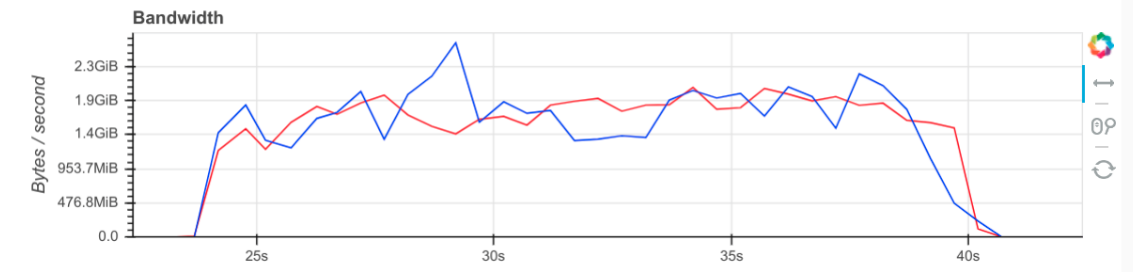
Dask inter-worker bandwidth is peaking at around 1.5-2GB/s on a network
theoretically capable of 3GB/s. [GitHub issue: pangeo #6](https://github.com/pangeo-data/pangeo/issues/6)
 _Network performance and Tornado compatibility are primarily being handled by
Antoine Pitrou._
## Parquet Compatibility
Dask.dataframe can use either of the two common Parquet libraries in Python,
Apache Arrow and Fastparquet. Each has its own strengths and its own base of
users who prefer it. We've significantly extended Dask's parquet test suite to
cover each library, extending roundtrip compatibility. Notably, you can now
both read and write with PyArrow.
```python
df.to_parquet('...', engine='fastparquet')
df = dd.read_parquet('...', engine='pyarrow')
```
There is still work to be done here. The variety of parquet reader/writers and
conventions out there makes completely solving this problem difficult. It's
nice seeing the various projects slowly converge on common functionality.
_This work was jointly done by Uwe Korn, Jim Crist, and Martin Durant._
## Retrying Tasks
One of the most requested features for the Dask.distributed scheduler is the
ability to retry failed tasks. This is particularly useful to people using
Dask as a task queue, rather than as a big dataframe or array.
```python
future = client.submit(func, *args, retries=5)
```
_Task retries were primarily built by Antoine Pitrou._
## Transactional Work Stealing
The Dask.distributed task scheduler performs load balancing through work
stealing. Previously this would sometimes result in the same task running
simultaneously in two locations. Now stealing is transactional, meaning that
it will avoid accidentally running the same task twice. This behavior is
especially important for people using Dask tasks for side effects.
It is still possible for the same task to run twice, but now this only happens
in more extreme situations, such as when a worker dies or a TCP connection is
severed, neither of which are common on standard hardware.
_Transactional work stealing was primarily implemented by Matthew Rocklin._
## New Diagnostic Pages
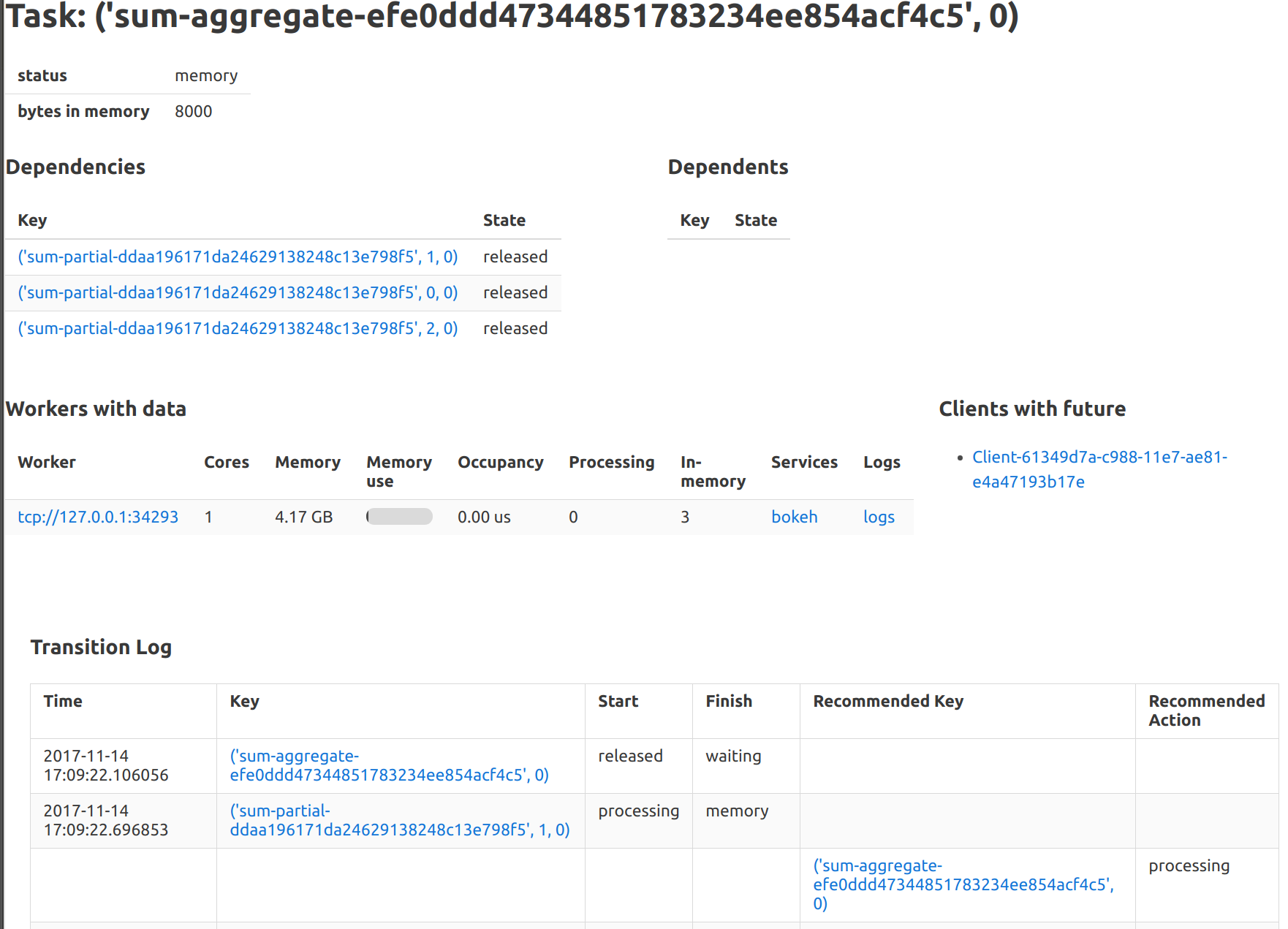
There is a new set of diagnostic web pages available in the _Info_ tab of the
dashboard. These pages provide more in-depth information about each worker and
task, but are not dynamic in any way. They use Tornado templates rather than
Bokeh plots, which means that they are less responsive but are much easier to
build. This is an easy and cheap way to expose more scheduler state.
_Network performance and Tornado compatibility are primarily being handled by
Antoine Pitrou._
## Parquet Compatibility
Dask.dataframe can use either of the two common Parquet libraries in Python,
Apache Arrow and Fastparquet. Each has its own strengths and its own base of
users who prefer it. We've significantly extended Dask's parquet test suite to
cover each library, extending roundtrip compatibility. Notably, you can now
both read and write with PyArrow.
```python
df.to_parquet('...', engine='fastparquet')
df = dd.read_parquet('...', engine='pyarrow')
```
There is still work to be done here. The variety of parquet reader/writers and
conventions out there makes completely solving this problem difficult. It's
nice seeing the various projects slowly converge on common functionality.
_This work was jointly done by Uwe Korn, Jim Crist, and Martin Durant._
## Retrying Tasks
One of the most requested features for the Dask.distributed scheduler is the
ability to retry failed tasks. This is particularly useful to people using
Dask as a task queue, rather than as a big dataframe or array.
```python
future = client.submit(func, *args, retries=5)
```
_Task retries were primarily built by Antoine Pitrou._
## Transactional Work Stealing
The Dask.distributed task scheduler performs load balancing through work
stealing. Previously this would sometimes result in the same task running
simultaneously in two locations. Now stealing is transactional, meaning that
it will avoid accidentally running the same task twice. This behavior is
especially important for people using Dask tasks for side effects.
It is still possible for the same task to run twice, but now this only happens
in more extreme situations, such as when a worker dies or a TCP connection is
severed, neither of which are common on standard hardware.
_Transactional work stealing was primarily implemented by Matthew Rocklin._
## New Diagnostic Pages
There is a new set of diagnostic web pages available in the _Info_ tab of the
dashboard. These pages provide more in-depth information about each worker and
task, but are not dynamic in any way. They use Tornado templates rather than
Bokeh plots, which means that they are less responsive but are much easier to
build. This is an easy and cheap way to expose more scheduler state.
 - [Existing templates](https://github.com/dask/distributed/tree/master/distributed/bokeh/templates)
## Nested compute calls
Calling `.compute()` _within_ a task now invokes the same distributed
scheduler. This enables writing more complex workloads with less thought to
starting worker clients.
```python
import dask
from dask.distributed import Client
client = Client() # only works for the newer scheduler
@dask.delayed
def f(x):
...
return dask.compute(...) # can call dask.compute within delayed task
dask.compute([f(i) for ...])
```
_Nested compute calls were primarily developed by Matthew Rocklin and Olivier
Grisel._
## More aggressive Garbage Collection
The workers now explicitly call `gc.collect()` at various times when under
memory pressure and when releasing data. This helps to avoid some memory
leaks, especially when using Pandas dataframes. Doing this carefully proved
to require a surprising degree of detail.
_Improved garbage collection was primarily implemented and tested by Fabian
Keller and Olivier Grisel, with recommendations by Antoine Pitrou._
## Related projects
### Dask-ML
A variety of Dask Machine Learning projects are now being assembled under one
unified repository, [dask-ml](http://dask-ml.readthedocs.io/en/latest/). We
encourage users and researchers alike to read through that project. We believe
there are many useful and interesting approaches contained within.
- Docs: [dask-ml.readthedocs.io](http://dask-ml.readthedocs.io/en/latest/)
- Github: [github.com/dask/dask-ml](https://github.com/dask/dask-ml)
_The work to assemble and curate these algorithms is primarily being handled by
Tom Augspurger._
### XArray
The [XArray](http://xarray.pydata.org/en/stable/) project for indexed and
labeled arrays is also releasing their major 0.10.0 release this week, which
includes many performance improvements, particularly for using Dask on larger
datasets.
- Docs: [xarray.pydata.org](http://xarray.pydata.org/en/stable/)
- Release notes: [xarray.pydata.org/en/latest/whats-new.html](http://xarray.pydata.org/en/latest/whats-new.html)
## Acknowledgements
The following people contributed to the dask/dask repository since the 0.15.3
release on September 24th:
- Ced4
- Christopher Prohm
- fjetter
- Hai Nguyen Mau
- Ian Hopkinson
- James Bourbeau
- James Munroe
- Jesse Vogt
- Jim Crist
- John Kirkham
- Keisuke Fujii
- Matthias Bussonnier
- Matthew Rocklin
- mayl
- Martin Durant
- Olivier Grisel
- severo
- Simon Perkins
- Stephan Hoyer
- Thomas A Caswell
- Tom Augspurger
- Uwe L. Korn
- Wei Ji
- xwang777
The following people contributed to the dask/distributed repository since the
1.19.1 release on September 24nd:
- Alvaro Ulloa
- Antoine Pitrou
- chkoar
- Fabian Keller
- Ian Hopkinson
- Jim Crist
- Kelvin Yang
- Krisztián Szűcs
- Matthew Rocklin
- Mike DePalatis
- Olivier Grisel
- rbubley
- Tom Augspurger
The following people contributed to the dask/dask-ml repository
- Evan Welch
- Matthew Rocklin
- severo
- Tom Augspurger
- Trey Causey
In addition, we are proud to announce that Olivier Grisel has accepted commit
rights to the Dask projects. Olivier has been particularly active on the
distributed scheduler, and on related projects like Joblib, SKLearn, and
Cloudpickle.
- [Existing templates](https://github.com/dask/distributed/tree/master/distributed/bokeh/templates)
## Nested compute calls
Calling `.compute()` _within_ a task now invokes the same distributed
scheduler. This enables writing more complex workloads with less thought to
starting worker clients.
```python
import dask
from dask.distributed import Client
client = Client() # only works for the newer scheduler
@dask.delayed
def f(x):
...
return dask.compute(...) # can call dask.compute within delayed task
dask.compute([f(i) for ...])
```
_Nested compute calls were primarily developed by Matthew Rocklin and Olivier
Grisel._
## More aggressive Garbage Collection
The workers now explicitly call `gc.collect()` at various times when under
memory pressure and when releasing data. This helps to avoid some memory
leaks, especially when using Pandas dataframes. Doing this carefully proved
to require a surprising degree of detail.
_Improved garbage collection was primarily implemented and tested by Fabian
Keller and Olivier Grisel, with recommendations by Antoine Pitrou._
## Related projects
### Dask-ML
A variety of Dask Machine Learning projects are now being assembled under one
unified repository, [dask-ml](http://dask-ml.readthedocs.io/en/latest/). We
encourage users and researchers alike to read through that project. We believe
there are many useful and interesting approaches contained within.
- Docs: [dask-ml.readthedocs.io](http://dask-ml.readthedocs.io/en/latest/)
- Github: [github.com/dask/dask-ml](https://github.com/dask/dask-ml)
_The work to assemble and curate these algorithms is primarily being handled by
Tom Augspurger._
### XArray
The [XArray](http://xarray.pydata.org/en/stable/) project for indexed and
labeled arrays is also releasing their major 0.10.0 release this week, which
includes many performance improvements, particularly for using Dask on larger
datasets.
- Docs: [xarray.pydata.org](http://xarray.pydata.org/en/stable/)
- Release notes: [xarray.pydata.org/en/latest/whats-new.html](http://xarray.pydata.org/en/latest/whats-new.html)
## Acknowledgements
The following people contributed to the dask/dask repository since the 0.15.3
release on September 24th:
- Ced4
- Christopher Prohm
- fjetter
- Hai Nguyen Mau
- Ian Hopkinson
- James Bourbeau
- James Munroe
- Jesse Vogt
- Jim Crist
- John Kirkham
- Keisuke Fujii
- Matthias Bussonnier
- Matthew Rocklin
- mayl
- Martin Durant
- Olivier Grisel
- severo
- Simon Perkins
- Stephan Hoyer
- Thomas A Caswell
- Tom Augspurger
- Uwe L. Korn
- Wei Ji
- xwang777
The following people contributed to the dask/distributed repository since the
1.19.1 release on September 24nd:
- Alvaro Ulloa
- Antoine Pitrou
- chkoar
- Fabian Keller
- Ian Hopkinson
- Jim Crist
- Kelvin Yang
- Krisztián Szűcs
- Matthew Rocklin
- Mike DePalatis
- Olivier Grisel
- rbubley
- Tom Augspurger
The following people contributed to the dask/dask-ml repository
- Evan Welch
- Matthew Rocklin
- severo
- Tom Augspurger
- Trey Causey
In addition, we are proud to announce that Olivier Grisel has accepted commit
rights to the Dask projects. Olivier has been particularly active on the
distributed scheduler, and on related projects like Joblib, SKLearn, and
Cloudpickle.