---
blogpost: true
date: Jan 24, 2017
title: Custom Parallel Algorithms on a Cluster with Dask
tags: Programming, Python, scipy
---
_This work is supported by [Continuum Analytics](http://continuum.io)
the [XDATA Program](http://www.darpa.mil/program/XDATA)
and the Data Driven Discovery Initiative from the [Moore
Foundation](https://www.moore.org/)_
### Summary
This post describes Dask as a computational task scheduler that fits somewhere
on a spectrum between big data computing frameworks like Hadoop/Spark and task
schedulers like Airflow/Celery/Luigi. We see how, by combining elements from
both of these types of systems Dask is able to handle complex data science
problems particularly well.
This post is in contrast to two recent posts on structured parallel
collections:
1. [Distributed DataFrames](https://mrocklin.github.com/blog/work/2017/01/12/dask-dataframes)
2. [Distributed Arrays](https://mrocklin.github.com/blog/work/2017/01/17/dask-images)
### Big Data Collections
Most distributed computing systems like Hadoop or Spark or SQL databases
implement a small but powerful set of parallel operations like map, reduce,
groupby, and join. As long as you write your programs using only those
operations then the platforms understand your program and serve you well. Most
of the time this is great because most big data problems are pretty simple.
However, as we explore new complex algorithms or messier data science problems,
these large parallel operations start to become insufficiently flexible. For
example, consider the following data loading and cleaning problem:
1. Load data from 100 different files (this is a simple `map` operation)
2. Also load a reference dataset from a SQL database (not parallel at all, but
could run alongside the map above)
3. Normalize each of the 100 datasets against the reference dataset (sort of
like a map, but with another input)
4. Consider a sliding window of every three normalized datasets (Might be able
to hack this with a very clever join? Not sure.)
5. Of all of the 98 outputs of the last stage, consider all pairs. (Join or
cartesian product) However, because we don't want to compute all ~10000
possibilities, let's just evaluate a random sample of these pairs
6. Find the best of all of these possibilities (reduction)
In sequential for-loopy code this might look like the following:
```python
filenames = ['mydata-%d.dat' % i for i in range(100)]
data = [load(fn) for fn in filenames]
reference = load_from_sql('sql://mytable')
processed = [process(d, reference) for d in data]
rolled = []
for i in range(len(processed) - 2):
a = processed[i]
b = processed[i + 1]
c = processed[i + 2]
r = roll(a, b, c)
rolled.append(r)
compared = []
for i in range(200):
a = random.choice(rolled)
b = random.choice(rolled)
c = compare(a, b)
compared.append(c)
best = reduction(compared)
```
This code is clearly parallelizeable, but it's not clear how to write it down
as a MapReduce program, a Spark computation, or a SQL query. These tools
generally fail when asked to express complex or messy problems. We can still
use Hadoop/Spark to solve this problem, but we are often forced to change and
simplify our objectives a bit. (This problem is not particularly complex, and I
suspect that there are clever ways to do it, but it's not trivial and often
inefficient.)
### Task Schedulers
So instead people use task schedulers like Celery, Luigi, or Airflow. These
systems track hundreds of _tasks_, each of which is just a normal Python
function that runs on some normal Python data. The task scheduler tracks
dependencies between tasks and so runs as many as it can at once if they don't
depend on each other.
This is a far more granular approach than the Big-Bulk-Collection approach of
MapReduce and Spark. However systems like Celery, Luigi, and Airflow are also
generally less efficient. This is both because they know less about their computations (map is much easier to schedule than an arbitrary graph) and because they just don't have machinery for inter-worker communication, efficient serialization of custom datatypes, etc..
### Dask Mixes Task Scheduling with Efficient Computation
Dask is both a big data system like Hadoop/Spark that is aware of resilience,
inter-worker communication, live state, etc. and also a general task scheduler
like Celery, Luigi, or Airflow, capable of arbitrary task execution.
Many Dask users use something like Dask dataframe, which generates these graphs
automatically, and so never really observe the task scheduler aspect of Dask
This is, however, the core of what distinguishes Dask from other systems like
Hadoop and Spark. Dask is incredibly _flexible_ in the kinds of algorithms it
can run. This is because, at its core, it can run _any_ graph of tasks and not
just map, reduce, groupby, join, etc.. Users can do this natively, without
having to subclass anything or extend Dask to get this extra power.
There are significant performance advantages to this. For example:
1. Dask.dataframe can easily represent nearest neighbor computations for
fast time-series algorithms
2. Dask.array can implement complex linear algebra solvers or SVD algorithms
from the latest research
3. Complex Machine Learning algorithms are often easier to implement in Dask,
allowing it to be more efficient through smarter algorithms, as well as
through scalable computing.
4. Complex hierarchies from bespoke data storage solutions can be explicitly
modeled and loaded in to other Dask systems
This doesn't come for free. Dask's scheduler has to be very intelligent to
smoothly schedule arbitrary graphs while still optimizing for data locality,
worker failure, minimal communication, load balancing, scarce resources like
GPUs and more. It's a tough job.
### Dask.delayed
So let's go ahead and run the data ingestion job described with Dask.
We craft some fake functions to simulate actual work:
```python
import random
from time import sleep
def load(address):
sleep(random.random() / 2)
def load_from_sql(address):
sleep(random.random() / 2 + 0.5)
def process(data, reference):
sleep(random.random() / 2)
def roll(a, b, c):
sleep(random.random() / 5)
def compare(a, b):
sleep(random.random() / 10)
def reduction(seq):
sleep(random.random() / 1)
```
We annotate these functions with `dask.delayed`, which changes a function so
that instead of running immediately it captures its inputs and puts everything
into a task graph for future execution.
```python
from dask import delayed
load = delayed(load)
load_from_sql = delayed(load_from_sql)
process = delayed(process)
roll = delayed(roll)
compare = delayed(compare)
reduction = delayed(reduction)
```
Now we just call our normal Python for-loopy code from before. However now
rather than run immediately our functions capture a computational graph that
can be run elsewhere.
```python
filenames = ['mydata-%d.dat' % i for i in range(100)]
data = [load(fn) for fn in filenames]
reference = load_from_sql('sql://mytable')
processed = [process(d, reference) for d in data]
rolled = []
for i in range(len(processed) - 2):
a = processed[i]
b = processed[i + 1]
c = processed[i + 2]
r = roll(a, b, c)
rolled.append(r)
compared = []
for i in range(200):
a = random.choice(rolled)
b = random.choice(rolled)
c = compare(a, b)
compared.append(c)
best = reduction(compared)
```
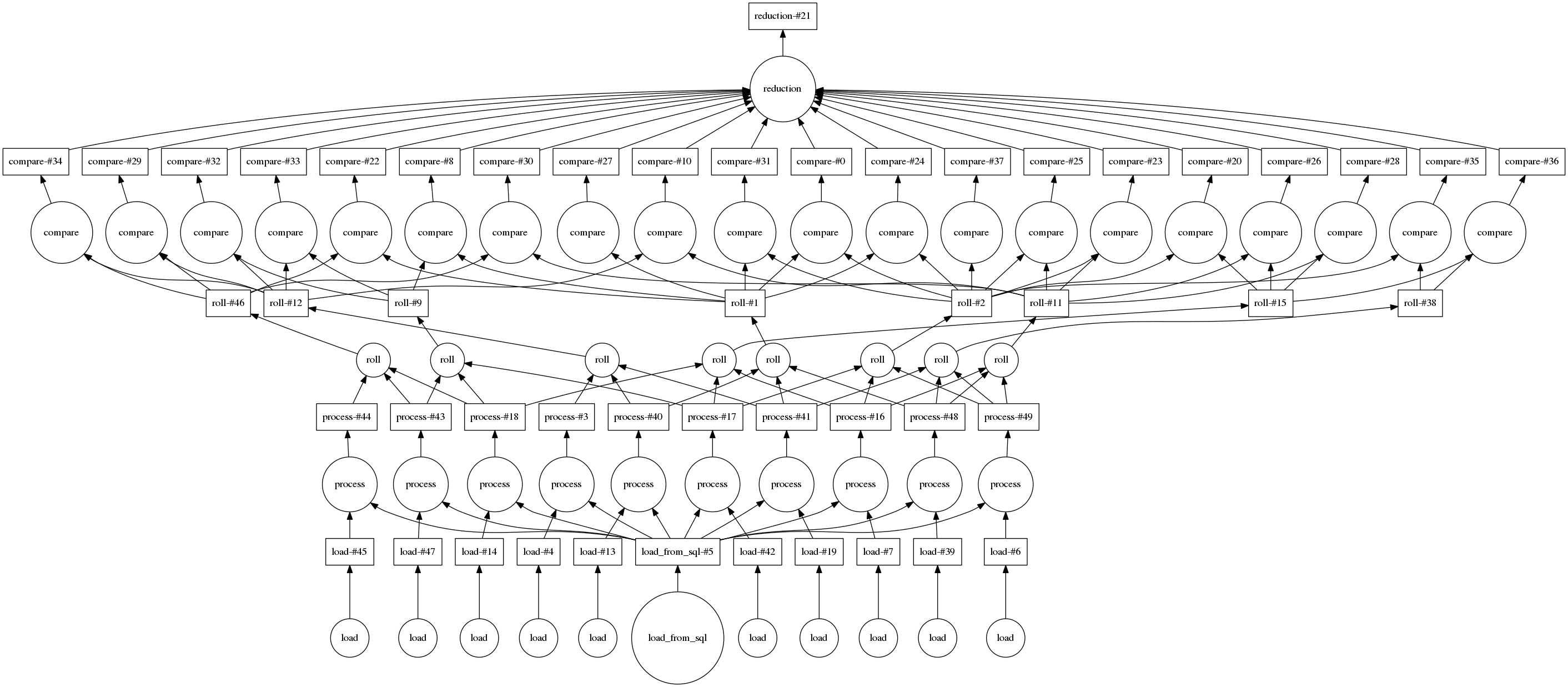
Here is an image of that graph for a smaller input of only 10 files and 20
random pairs
 We can connect to a small cluster with 20 cores
```python
from dask.distributed import Client
client = Client('scheduler-address:8786')
```
We compute the result and see the trace of the computation running in real
time.
```python
result = best.compute()
```
We can connect to a small cluster with 20 cores
```python
from dask.distributed import Client
client = Client('scheduler-address:8786')
```
We compute the result and see the trace of the computation running in real
time.
```python
result = best.compute()
```
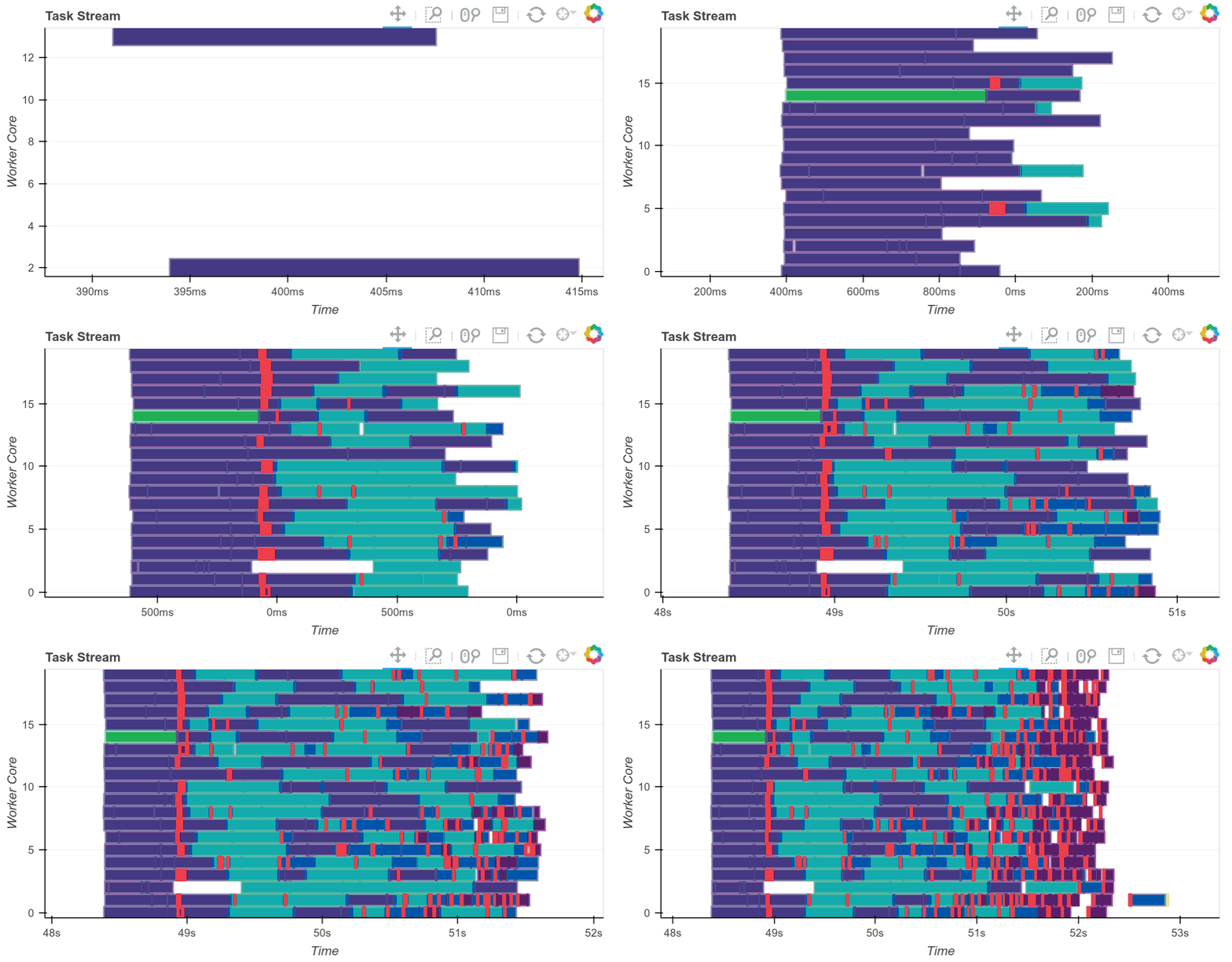 The completed [Bokeh](https://bokeh.pydata.org) image below is interactive.
You can pan and zoom by selecting the tools in the upper right. You can see
every task, which worker it ran on and how long it took by hovering over the
rectangles.
We see that we use all 20 cores well. Intermediate results are transferred
between workers as necessary (these are the red rectangles). We can scale this
up as necessary. Dask scales to thousands of cores.
## Final Thoughts
Dask's ability to write down arbitrary computational graphs
Celery/Luigi/Airflow-style and yet run them with the scalability promises of
Hadoop/Spark allows for a pleasant freedom to write comfortably and yet still
compute scalably. This ability opens up new possibilities both to support more
sophisticated algorithms and also to handle messy situations that arise in the
real world (enterprise data systems are sometimes messy) while still remaining
within the bounds of "normal and supported" Dask operation.
The completed [Bokeh](https://bokeh.pydata.org) image below is interactive.
You can pan and zoom by selecting the tools in the upper right. You can see
every task, which worker it ran on and how long it took by hovering over the
rectangles.
We see that we use all 20 cores well. Intermediate results are transferred
between workers as necessary (these are the red rectangles). We can scale this
up as necessary. Dask scales to thousands of cores.
## Final Thoughts
Dask's ability to write down arbitrary computational graphs
Celery/Luigi/Airflow-style and yet run them with the scalability promises of
Hadoop/Spark allows for a pleasant freedom to write comfortably and yet still
compute scalably. This ability opens up new possibilities both to support more
sophisticated algorithms and also to handle messy situations that arise in the
real world (enterprise data systems are sometimes messy) while still remaining
within the bounds of "normal and supported" Dask operation.