---
blogpost: true
date: Dec 24, 2016
title: Dask Development Log
tags: Programming, Python, scipy
---
_This work is supported by [Continuum Analytics](http://continuum.io)
the [XDATA Program](http://www.darpa.mil/program/XDATA)
and the Data Driven Discovery Initiative from the [Moore
Foundation](https://www.moore.org/)_
To increase transparency I'm blogging weekly about the work done on Dask and
related projects during the previous week. This log covers work done between
2016-12-11 and 2016-12-18. Nothing here is ready for production. This
blogpost is written in haste, so refined polish should not be expected.
Themes of last week:
1. Cleanup of load balancing
2. Found cause of worker lag
3. Initial Spark/Dask Dataframe comparisons
4. Benchmarks with asv
### Load Balancing Cleanup
The last two weeks saw several disruptive changes to the scheduler and workers.
This resulted in an overall performance degradation on messy workloads when
compared to the most recent release, which stopped bleeding-edge users from
using recent dev builds. This has been resolved, and bleeding-edge git-master
is back up to the old speed and then some.
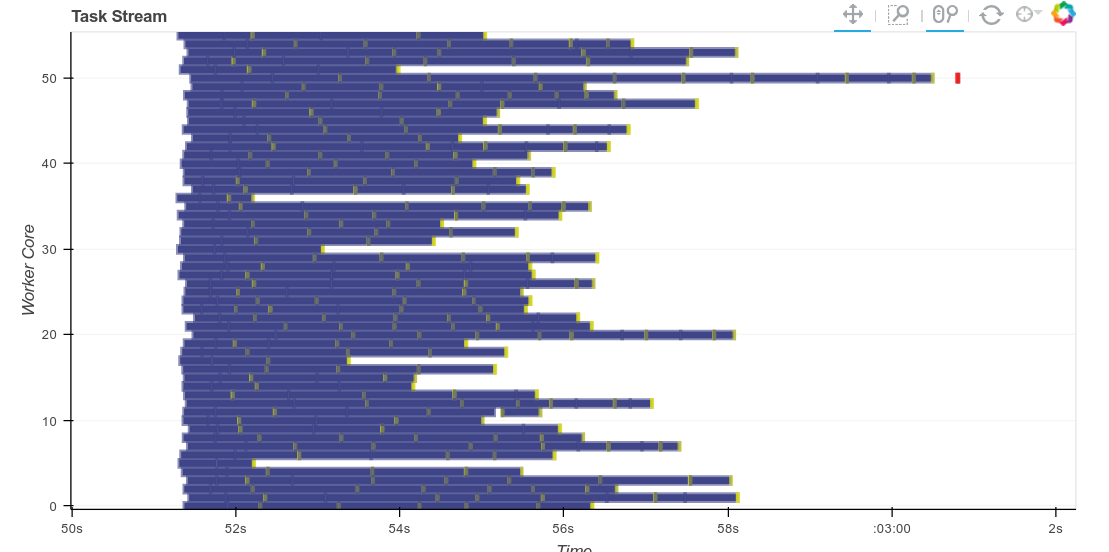
As a visual aid, this is what bad (or in this case random) load balancing looks
like:
 ### Identified and removed worker lag
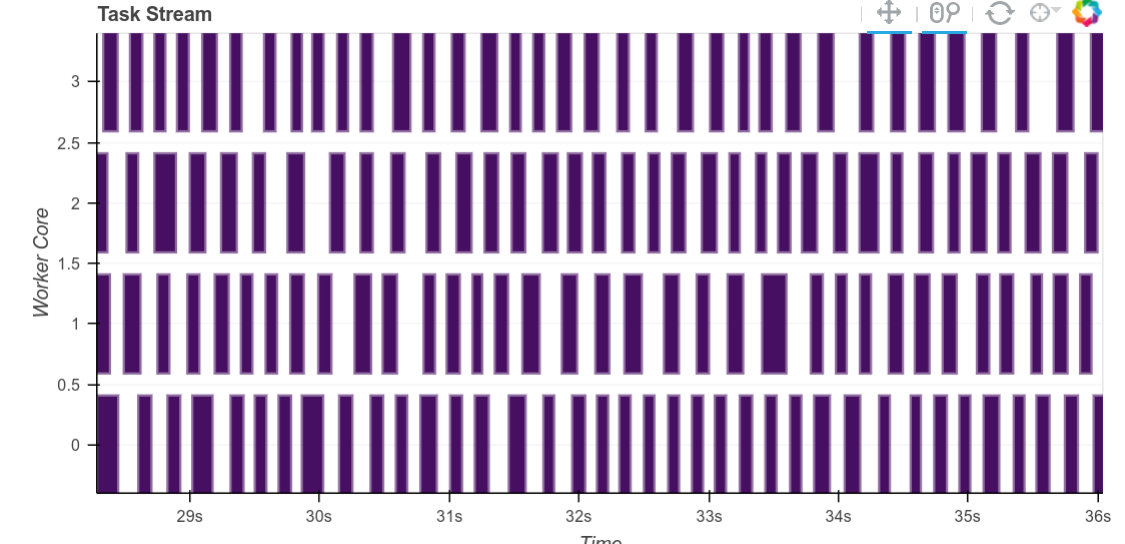
For a while there have been significant gaps of 100ms or more between successive
tasks in workers, especially when using Pandas. This was particularly odd
because the workers had lots of backed up work to keep them busy (thanks to the
nice load balancing from before). The culprit here was the calculation of the
size of the intermediate on object dtype dataframes.
### Identified and removed worker lag
For a while there have been significant gaps of 100ms or more between successive
tasks in workers, especially when using Pandas. This was particularly odd
because the workers had lots of backed up work to keep them busy (thanks to the
nice load balancing from before). The culprit here was the calculation of the
size of the intermediate on object dtype dataframes.
 Explaining this in greater depth, recall that to schedule intelligently, the
workers calculate the size in bytes of every intermediate result they produce.
Often this is quite fast, for example for numpy arrays we can just multiply the
number of elements by the dtype itemsize. However for object dtype arrays or
dataframes (which are commonly used for text) it can take a long while to
calculate an accurate result here. Now we no longer calculuate an accurate
result, but instead take a fairly pessimistic guess. The gaps between tasks
shrink considerably.
Explaining this in greater depth, recall that to schedule intelligently, the
workers calculate the size in bytes of every intermediate result they produce.
Often this is quite fast, for example for numpy arrays we can just multiply the
number of elements by the dtype itemsize. However for object dtype arrays or
dataframes (which are commonly used for text) it can take a long while to
calculate an accurate result here. Now we no longer calculuate an accurate
result, but instead take a fairly pessimistic guess. The gaps between tasks
shrink considerably.
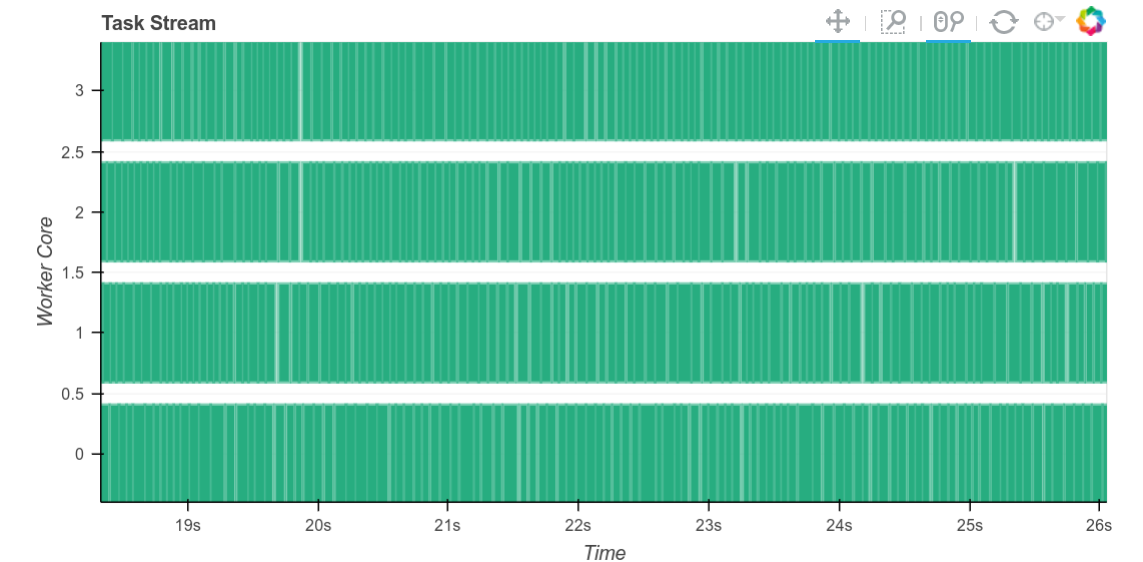
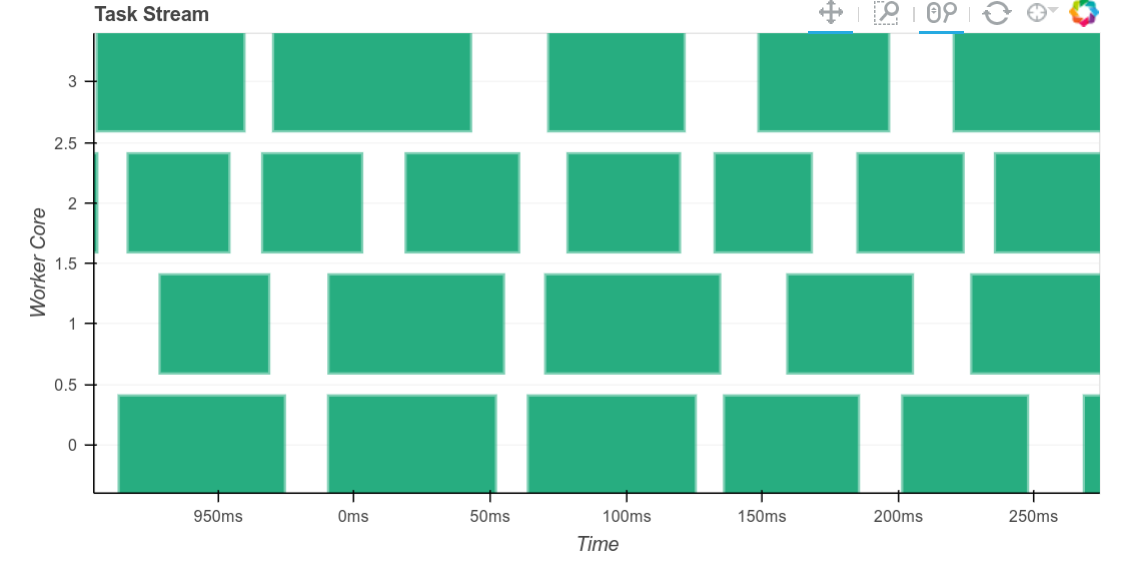 Although there is still a significant bit of lag around 10ms long between tasks
on these workloads (see zoomed version on the right). On other workloads we're
able to get inter-task lag down to the tens of microseconds scale. While 10ms
may not sound like a long time, when we perform very many very short tasks this
can quickly become a bottleneck.
Anyway, this change reduced shuffle overhead by a factor of two. Things are
starting to look pretty snappy for many-small-task workloads.
### Initial Spark/Dask Dataframe Comparisons
I would like to run a small benchmark comparing Dask and Spark DataFrames. I
spent a bit of the last couple of days using Spark locally on the NYC Taxi data
and futzing with cluster deployment tools to set up Spark clusters on EC2 for
basic benchmarking. I ran across
[flintrock](https://github.com/nchammas/flintrock), which has been highly
recommended to me a few times.
I've been thinking about how to do benchmarks in an unbiased way. Comparative
benchmarks are useful to have around to motivate projects to grow and learn
from each other. However in today's climate where open source software
developers have a vested interest, benchmarks often focus on a projects'
strengths and hide their deficiencies. Even with the best of intentions and
practices, a developer is likely to correct for deficiencies on the fly.
They're much more able to do this for their own project than for others'.
Benchmarks end up looking more like sales documents than trustworthy research.
My tentative plan is to reach out to a few Spark devs and see if we can
collaborate on a problem set and hardware before running computations and
comparing results.
### Benchmarks with airspeed velocity
[Rich Postelnik](https://github.com/postelrich) is building on work from
[Tom Augspurger](https://github.com/TomAugspurger) to build out benchmarks for
Dask using [airspeed velocity](https://github.com/spacetelescope/asv) at
[dask-benchmarks](https://github.com/dask/dask-benchmarks). Building out
benchmarks is a great way to get involved if anyone is interested.
### Pre-pre-release
I intend to publish a pre-release for a 0.X.0 version bump of dask/dask and
dask/distributed sometime next week.
Although there is still a significant bit of lag around 10ms long between tasks
on these workloads (see zoomed version on the right). On other workloads we're
able to get inter-task lag down to the tens of microseconds scale. While 10ms
may not sound like a long time, when we perform very many very short tasks this
can quickly become a bottleneck.
Anyway, this change reduced shuffle overhead by a factor of two. Things are
starting to look pretty snappy for many-small-task workloads.
### Initial Spark/Dask Dataframe Comparisons
I would like to run a small benchmark comparing Dask and Spark DataFrames. I
spent a bit of the last couple of days using Spark locally on the NYC Taxi data
and futzing with cluster deployment tools to set up Spark clusters on EC2 for
basic benchmarking. I ran across
[flintrock](https://github.com/nchammas/flintrock), which has been highly
recommended to me a few times.
I've been thinking about how to do benchmarks in an unbiased way. Comparative
benchmarks are useful to have around to motivate projects to grow and learn
from each other. However in today's climate where open source software
developers have a vested interest, benchmarks often focus on a projects'
strengths and hide their deficiencies. Even with the best of intentions and
practices, a developer is likely to correct for deficiencies on the fly.
They're much more able to do this for their own project than for others'.
Benchmarks end up looking more like sales documents than trustworthy research.
My tentative plan is to reach out to a few Spark devs and see if we can
collaborate on a problem set and hardware before running computations and
comparing results.
### Benchmarks with airspeed velocity
[Rich Postelnik](https://github.com/postelrich) is building on work from
[Tom Augspurger](https://github.com/TomAugspurger) to build out benchmarks for
Dask using [airspeed velocity](https://github.com/spacetelescope/asv) at
[dask-benchmarks](https://github.com/dask/dask-benchmarks). Building out
benchmarks is a great way to get involved if anyone is interested.
### Pre-pre-release
I intend to publish a pre-release for a 0.X.0 version bump of dask/dask and
dask/distributed sometime next week.